
Introduction:
In a world driven by rapid digital transformation, one form of artificial intelligence is making particularly big waves. Whether it’s ChatGPT writing code and essays, Midjourney generating stunning images, or Sora by OpenAI creating realistic videos, generative AI is revolutionizing how we create, communicate, and innovate.
This technology has moved from being an experimental novelty to a practical, scalable tool that’s impacting businesses, education, healthcare, art, marketing, software development, and more. Its ability to produce human-like content—from text and images to video and music—has unlocked new possibilities and raised important questions.
In this in-depth blog post, we will explore what is, how it works, key technologies behind it, top use cases, major benefits, pressing challenges, ethical concerns, and what the future may hold. This is your complete guide to understanding the potential and implications of generative AI in our daily lives and industries.
In a world increasingly driven by artificial intelligence, Generative AI stands at the forefront of innovation—transforming industries, reshaping creativity, and empowering professionals with next-generation tools. If you’re ready to take your skills to the next level, Hope Infotech invites you to explore our cutting-edge Generative AI Online Training Program.

1. What Is Generative AI?
Definition
Generative AI refers to a subset of artificial intelligence models that can generate new data or content—such as text, images, music, audio, videos, or code—based on the data they have been trained on. These models don’t just analyze or classify existing data; they create something entirely new, often mimicking human creativity and decision-making.
Core Concept
At its heart, uses machine learning to identify patterns in large datasets and then extrapolate from those patterns to create original content. The outputs can range from paragraphs of coherent writing to realistic portraits or voices that never existed before.
2. Does Generative AI Work?
Machine Learning and Deep Learning
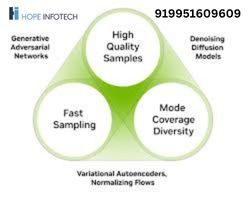
Generative AI is typically built on deep learning, especially neural networks that mimic how the human brain processes information. The key components include
- Neural Networks: Used to identify relationships and patterns in data.
- Training Data: Vast datasets (text, images, video, etc.) used to “teach” the model.
- Learning Algorithms: Guide the model in refining its outputs.
Types of Models
There are several model architectures in generative AI:
a. Generative Adversarial Networks (GANs)
- Introduced by Ian Goodfellow in 2014.
- It comprises two networks: a generator that creates content and a discriminator that evaluates it.
- Used for image generation, deepfakes, fashion design, etc.
b. Variational Autoencoders (VAEs)
- Encode input data into a latent space and decode it into output.
- Used in image and speech generation.
c. Transformer-based Models
- Includes GPT (Generative Pre-trained Transformer), BERT, T5, and others.
- Leverages self-attention mechanisms to process sequences of data.
- Most widely used in natural language generation (NLG) and text-to-text tasks.
3. Real-World Use Cases of Generative AI
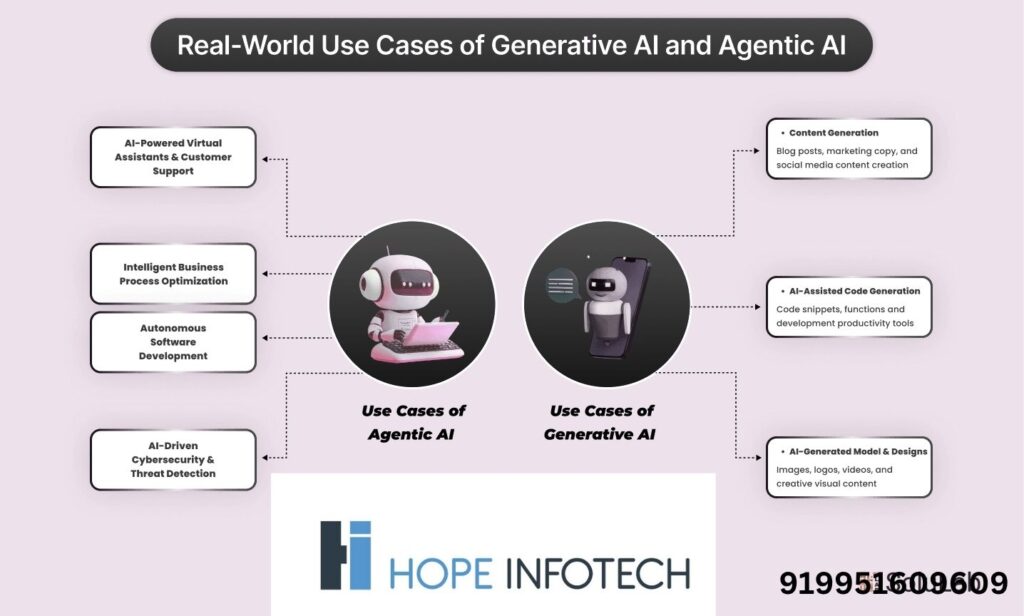
3.1 Content Generation
- Blog posts, articles, and reports
- SEO-optimized website content
- Email campaigns and newsletters
- Product descriptions for e-commerce
Example: ChatGPT writing personalized email responses for customer support or Jasper.ai generating copy for marketing teams.
3.2 Image and Design Generation
- AI-generated artwork and illustrations
- Logo and graphic design
- Fashion prototypes and interior layouts
- Synthetic photography
Example: Midjourney or DALL·E creating hyper-realistic or abstract visuals from textual prompts.
3.3 Code Generation
- Autocompletion for developers
- Code translation between languages
- Debugging and unit test generation
Example: GitHub Copilot helping developers speed up programming tasks in real time.
3.4 Video and Audio Creation
- Video generation from text (e.g., Sora)
- Voice cloning and synthesis
- Music composition
- Lip-syncing and dubbing
Example: Synthesia producing AI-generated presenters or TikTok voice filters.
3.5 Healthcare
- Synthetic medical data for research
- Drug molecule design
- Medical imaging analysis
Example: Using generative AI to simulate rare disease data for AI model training while preserving patient anonymity.
3.6 Education and E-Learning
- Personalized tutoring bots
- Simplified concept explanations
- Quiz and assignment creation
Example: Khanmigo by Khan Academy uses GPT models for tutoring assistance.
3.7 Gaming and Virtual Worlds
- Character design and dialogue scripting
- Procedural worldbuilding
- Storyline generation
Example: AI Dungeon using GPT-3 to create interactive fiction experiences.
3.8 Business Intelligence
- Automated report generation
- Chatbots for customer service
- Presentation slides and data insights
Example: Tools like Tome or Beautiful. AI generates pitch decks automatically.
4. Benefits of Generative AI
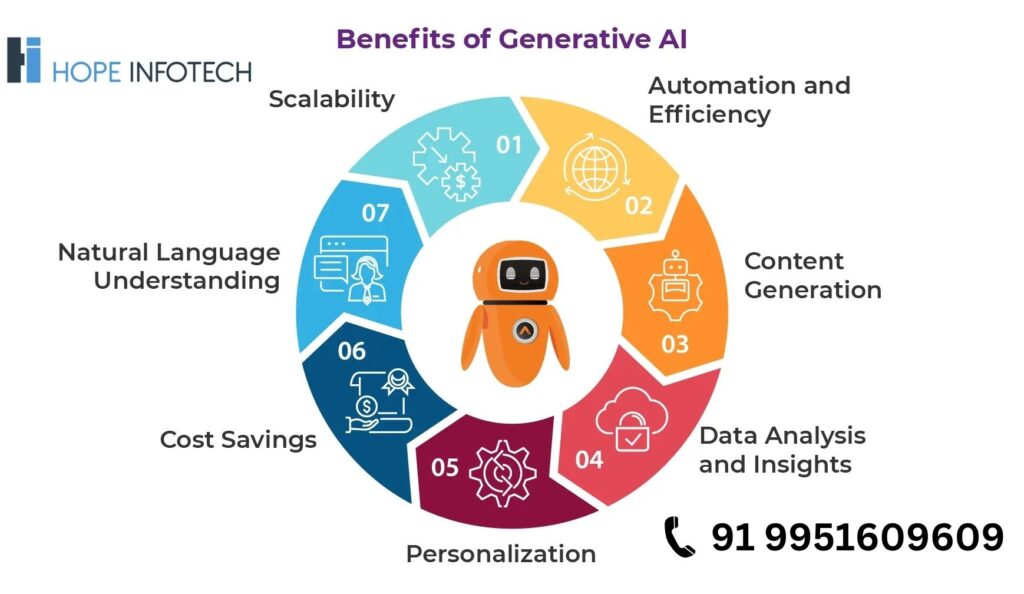
The transformative power of generative AI is driven by its benefits:
4.1 Boosted Creativity
It augments human imagination by suggesting new ideas, designs, and expressions.
4.2 Increased Productivity
Content creation that once took hours can now be completed in minutes.
4.3 Enhanced Personalization
Generative AI can customize content at scale—tailoring it to specific users, demographics, or preferences.
4.4 Lower Operational Costs
Companies can automate and streamline tasks, reducing the need for large creative or support teams.
4.5 Scalability
Enables businesses to produce massive volumes of content, designs, or code in a fraction of the usual time.
5. Limitations and Challenges
Despite the promise, generative AI is not without flaws.
5.1 Bias in Training Data
AI models reflect the data they are trained on. If that data is biased, the outputs will be too.
5.2 Misinformation and Deepfakes
Fake news, synthetic identities, and manipulated videos pose major ethical and legal threats.
5.3 Intellectual Property Concerns
Generated content may infringe on existing copyrights or trademarks.
5.4 Lack of Transparency
Black-box models can be hard to interpret or explain, making it difficult to identify why a model made a certain decision.
5.5 Over-Reliance
People may trust or depend on AI outputs without critical evaluation, leading to poor decisions.
6. Ethical Considerations and Governance
As generative AI becomes mainstream, ethical issues must be addressed:
6.1 Accountability
Who is responsible for AI-generated mistakes—the user, the developer, or the model creator?
6.2 Transparency
Users deserve to know when they are interacting with AI versus humans.
6.3 Data Privacy
Synthetic content generation often relies on massive datasets, which may contain personal or confidential information.
6.4 Regulation
Governments and institutions are still trying to catch up. The EU’s AI Act and the U.S. Blueprint for an AI Bill of Rights are early examples of regulatory efforts.
7. Tools and Platforms in the Generative AI Ecosystem
Here’s a look at some leading tools categorized by domain:
Text
- ChatGPT (OpenAI)
- Jasper
- Copy.ai
- Notion AI
Images
- DALL·E
- Midjourney
- RunwayML
- Adobe Firefly
Code
- GitHub Copilot
- Replit Ghostwriter
- Amazon CodeWhisperer
Video & Audio
- Sora by OpenAI
- Synthesia
- Pictory
- Eleven Labs
Enterprise
- Salesforce Einstein GPT
- Microsoft Copilot
- Google Gemini
Generative AI Online Course
8. Future Trends in Generative AI
8.1 Multimodal AI
Models that can understand and generate across multiple forms—text, images, video, and audio—in a single unified system.
8.2 Real-time Generation
We’ll soon see applications that generate content (like video games or personalized ads) on-the-fly based on user interaction.
8.3 Open-Source Alternatives
As companies worry about data privacy, open-source models like LLaMA, Mistral, and Falcon are gaining popularity.
8.4 Regulation-Driven Development
Expect AI models that are explainable, transparent, and privacy-respecting by design.
8.5 Integration into Everyday Tools
From Google Docs to Photoshop, generative AI will become a built-in assistant for every professional tool.
9. Generative AI and the Workforce
The workplace is already adapting:
9.1 Jobs Transformed, Not Replaced
AI won’t eliminate most jobs but will transform them. Content writers become editors, designers become curators, and developers become supervisors.
9.2 New Roles Emerging
- Prompt Engineers
- AI Ethicists
- Synthetic Data Specialists
- AI Experience Designers
9.3 Upskilling is Essential
As generative AI becomes a core business tool, digital literacy and prompt engineering skills will be key assets.
Conclusion:
Generative AI is more than a technological breakthrough—it’s a cultural, business, and creative shift that redefines what machines can do. It enhances human capability, democratizes access to creativity, and reshapes how content and ideas are produced.
But with great power comes great responsibility. Ensuring ethical use, preserving privacy, and encouraging transparency must go hand-in-hand with innovation.
As we look ahead, those who embrace—with curiosity, caution, and creativity—will be the ones to lead in the next era of the digital revolution.
Frequently Asked Questions (FAQs) About Generative AI
1. What is Generative AI?
Generative AI refers to a category of artificial intelligence that can generate new content — such as text, images, code, music, and video — based on the patterns it has learned from existing data. It goes beyond analyzing data to actually creating new data that mimics human-like creativity.
2. How is Generative AI different from traditional AI?
Traditional AI is focused on analyzing, predicting, and classifying existing data (e.g., spam filters, recommendation systems), whereas generative AI creates new content. For example, instead of just detecting objects in an image, generative AI can generate a new image of a cat or a realistic portrait from scratch.
3. What are some examples of generative AI tools?
Popular generative AI tools include:
- ChatGPT (text generation)
- DALL·E and Midjourney (image generation)
- GitHub Copilot (code completion)
- Sora (video generation)
- ElevenLabs (voice and audio generation)
- Runway ML (multimodal content)
4. Is generative AI safe to use?
Generative AI is generally safe for most applications, but risks include:
- Misinformation or deepfakes
- Biased outputs
- Data privacy concerns
- Overreliance on AI-generated content
Proper use, human oversight, and ethical guidelines are necessary to ensure safe deployment.
5. How does generative AI create content?
Generative AI models use deep learning, particularly:
- Generative Adversarial Networks (GANs) for image/video generation
- Transformer-based models (like GPT-4) for text/code generation
These models are trained on large datasets and learn to generate realistic content by identifying patterns and relationships in the data.
6. Can generative AI replace human jobs?
Generative AI is expected to augment rather than replace most jobs. It can automate repetitive tasks and assist professionals, allowing them to focus on higher-level thinking and creativity. However, some roles may evolve or be redefined, particularly in content creation, customer service, and software development.
7. Is content created by generative AI copyright-free?
This is a complex legal issue. Some generative AI tools allow commercial use, but the legal ownership of AI-generated content is still under debate. Always check the terms of use, copyright policies, and licensing agreements of the specific platform you’re using.
8. What industries are benefiting the most from generative AI?
Generative AI is transforming many industries, including:
- Marketing & Advertising
- Media & Entertainment
- Education & e-Learning
- Healthcare & Pharma
- Software Development
- E-commerce & Retail
Each industry uses it differently, from writing product descriptions to generating training materials or simulating patient data.
9. What are the ethical concerns surrounding generative AI?
Major ethical concerns include:
- Fake content and misinformation
- Bias in AI outputs
- Intellectual property violations
- Lack of transparency and accountability
Developers and organizations must implement responsible AI practices to mitigate these issues.
10. What is the future of generative AI?
The future of generative AI includes:
- Multimodal models that combine text, image, video, and audio
- Real-time content creation
- More personalized experiences
- Tighter AI regulations and ethical standards
- Deeper integration into daily tools and workflows